
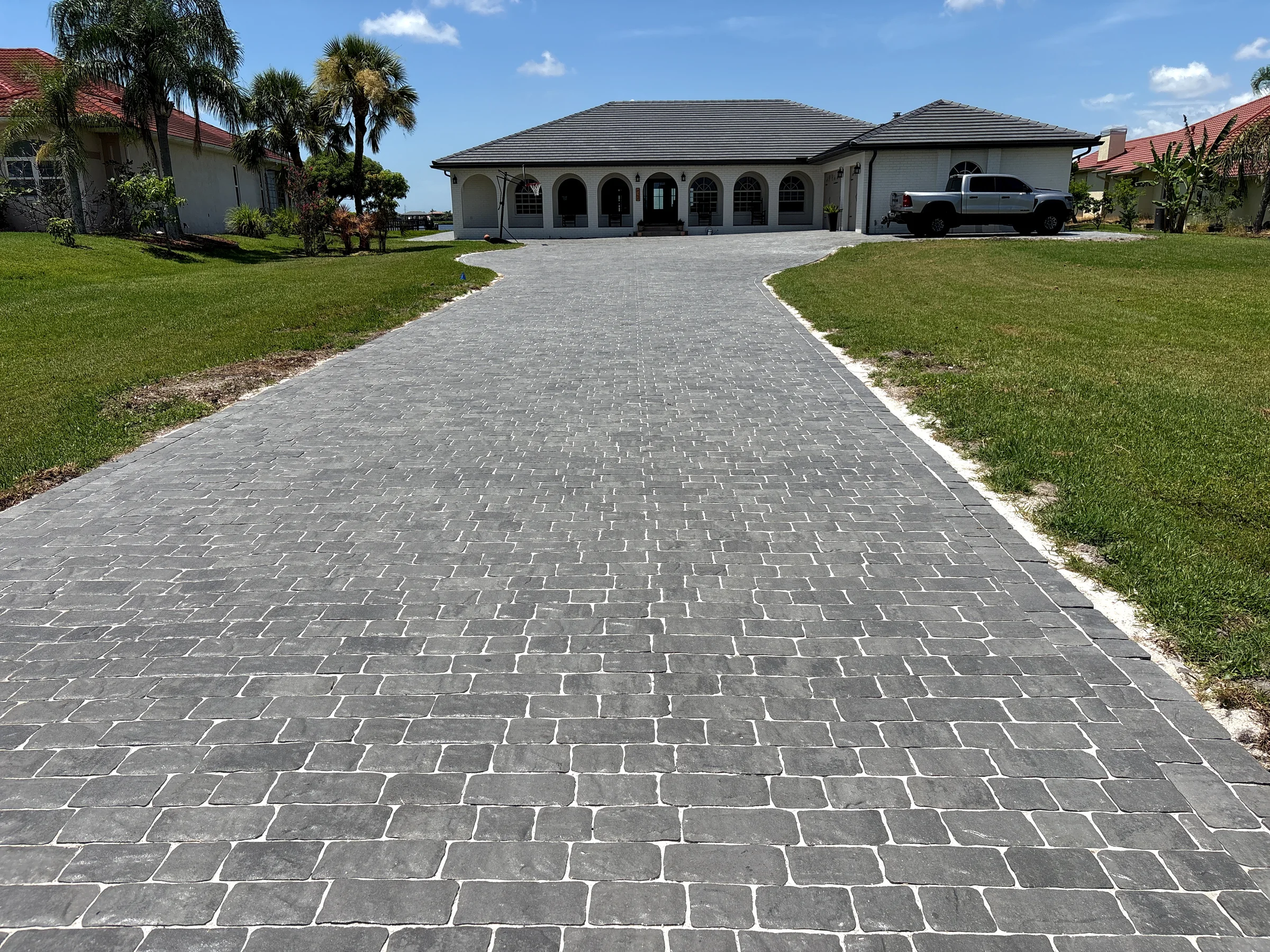
A useful paver driveway budget starts with the paved area, but it cannot end there. Two Lakewood Ranch driveways with the same square footage can carry different costs because removal, access, supporting conditions, drainage, paver selection, cuts, borders, and transitions are different. The clearest answer is not one statewide average. It is a complete written scope that shows what your total includes and what could change it.
Where the budget goes
Six parts of a complete paver driveway price
| Cost component | Why it changes | Look for in the estimate | Budget question |
|---|---|---|---|
| Area & geometry | More square footage means more material and labor; curves, narrow sections, and detailed layouts can add cuts and waste. | Measured driveway limits, apron and walk connections, pattern direction, border width, and how waste is handled. | Is every paved section included in the measured quantity? |
| Removal & access | Existing concrete or pavers may require demolition, loading, hauling, and disposal. Tight access can affect equipment and workflow. | What will be removed, what will remain, disposal responsibility, access route, and protection for adjoining surfaces. | Does the total include demolition and hauling? |
| Preparation & grade | Supporting conditions, excavation, preparation, compaction, elevations, and concealed conditions can change the work below the pavers. | The anticipated supporting assembly, finished elevations, edge restraint, and a written process for newly revealed conditions. | How will an unexpected condition be documented and priced? |
| Pavers & layout | Product, format, color blend, pattern, border, detailed cuts, availability, and order quantity all affect material and labor. | The exact product or allowance, pattern, border, joint material, substitutions, and sample or community approval steps. | Is the selected paver identified clearly enough to compare proposals? |
| Water & transitions | Low areas, drainage work, garage thresholds, walks, street aprons, utility covers, and landscape edges require site-specific detailing. | Included drainage work, intended grades, transition details, and any conditions specifically excluded from the driveway scope. | Where should rainwater go when the driveway is finished? |
| Approvals & schedule | Community review, applicable government requirements, material lead times, weather, and related work can affect the path to installation. | Responsibility for submittals, permit or review fees when applicable, selection deadlines, and schedule dependencies. | What must be approved before materials are ordered? |
The short answer: driveway cost is area plus scope
Square footage is the right place to begin because it helps estimate paver quantity and the scale of preparation. It is not a finished price by itself. A complete project may also include demolition, disposal, excavation, supporting material, compaction, drainage-related work, borders, detailed cuts, edge restraint, joint material, transitions, cleanup, and applicable approvals.
That is why a low per-square-foot figure can be misleading. It may describe only a simple field of standard pavers on an assumed site, while another proposal includes the old driveway removal, a contrasting border, grade correction, and difficult access. Before comparing totals, make sure both estimates cover the same driveway limits and responsibilities.
How to budget a 20-by-20 paver driveway
A 20-by-20-foot rectangle contains 400 square feet. That measurement gives you a useful starting quantity, not a guaranteed project total. The apron may flare toward the street, the garage may be wider than the main drive, and walk connections or parking extensions may sit outside the simple rectangle. A border also occupies part of the measured field and can change material quantities and cutting.
If you receive an installed square-foot rate, multiply it by 400 only after confirming what the rate includes. Then account for any separately priced removal, hauling, preparation, drainage, border, permit or community-review costs, and other site work. If those items are unknown, the calculation is a preliminary budget exercise rather than an estimate you can use to book construction.
The existing project estimator can help you begin a rough size-based budget, but its result does not replace a site-specific proposal. Final pricing should respond to the actual driveway, selected material, access, drainage, and written scope.
What tends to move a paver driveway quote up or down?
A simple rectangular driveway with open access, straightforward transitions, and a readily available paver is usually easier to price than a curved layout with a wide apron, multiple walk connections, detailed borders, drainage work, or restricted equipment access. That does not mean the simpler option is right for every home. It means design decisions should be visible in the price rather than buried in one unexplained rate.
Existing conditions can matter just as much as the design. Settlement, recurring low spots, moving edges, tree roots, utility structures, or an unclear street connection deserve attention before the new surface is installed. Ask what the estimator can evaluate in advance, what remains concealed until removal, and how any change would be discussed and authorized.
Are pavers cheaper than a concrete driveway?
Not automatically. Pavers and poured concrete are different systems with different material, labor, preparation, detailing, maintenance, and repair considerations. A basic concrete proposal may cost less than a detailed paver installation, while demolition, finish choices, reinforcement, drainage, access, or site correction can change either comparison.
For a fair decision, compare equivalent finished scopes. Include removal and disposal, preparation, grade and drainage work, the specified surface and finish, borders or reinforcement, transitions, cleanup, care guidance, and the process for changes. Pavers provide broad pattern and border options and a modular surface; concrete creates a continuous poured surface with its own finish and joint decisions. The better value is the complete system that fits your home, priorities, and ownership expectations.
Lakewood Ranch pricing starts with the address
Lakewood Ranch spans parts of Manatee and Sarasota counties, and individual communities may have their own design-review requirements. Paver color, border treatment, driveway limits, apron work, drainage changes, or work near a sidewalk or right-of-way may require property-specific confirmation. An approval at another home does not establish the current path for yours.
The address also helps frame existing grades, site access, neighborhood construction, and the authority that applies to the work. Gather current community criteria and a survey if you have them, and note where water moves after heavy rain. Sorting those details out before material ordering helps keep the proposal, approvals, and schedule aligned.
Compare driveway estimates line by line
A useful estimate should identify the driveway limits, measured area, removal and disposal, anticipated preparation, selected paver or allowance, pattern, borders, cuts, edge restraint, joints, transitions, drainage-related work, cleanup, schedule dependencies, payment terms, care information, and process for concealed conditions or requested changes. If a responsibility is excluded, it should be understandable before you sign.
Separate price from completeness. The lowest total is not necessarily the lowest finished cost if it leaves removal, drainage, an apron, or a necessary transition unresolved. The strongest comparison puts each proposal on the same checklist, then weighs appearance, scope, schedule, communication, maintenance, and total price together.
Remember the cost of owning the driveway
A paver driveway is not maintenance-free. Routine sweeping, prompt stain care, vegetation control, joint upkeep, open drainage paths, and occasional checks for settlement or moving edges are part of keeping the surface in good condition. Cleaning methods should suit the exact paver and joint system; overly aggressive washing can disturb joints or affect the finish.
Sealing is not an automatic line item for every driveway. Ask what the selected product and joint-material guidance recommends, what a proposed treatment is meant to accomplish, whether it changes color or sheen, and what future cleaning or reapplication could involve. Those expectations belong in the buying decision even when they are not part of the initial installation total.
Quick answers
Paver driveway cost FAQs
How much does a 20x20 paver driveway cost?
A 20x20 rectangle is 400 square feet, but dimensions alone do not determine a reliable installed price. Confirm the complete measured area and whether the proposal includes removal, hauling, preparation, drainage, paver selection, pattern, borders, cuts, edges, joints, transitions, cleanup, and applicable approvals.
How much does a paver driveway cost in Florida?
There is no single Florida price that fits every driveway. Area, existing-surface removal, access, supporting conditions, grade and drainage work, paver selection, pattern, borders, transitions, local requirements, and concealed conditions can all change the project-specific estimate.
Is it cheaper to do a concrete or paver driveway?
Either complete proposal may be lower depending on the property and selected finish. Compare equivalent scopes for demolition, preparation, drainage, materials, borders or reinforcement, transitions, cleanup, maintenance, and repair expectations rather than comparing surface-only rates.
How much does an average paver driveway cost?
An average can hide the variables that matter most at your home. Use measured area to begin budgeting, then request a written site-specific scope that identifies the material, preparation, removal, drainage, access, transitions, cleanup, and potential changes behind the total.
What should be included in a paver driveway estimate?
Look for defined project limits, measured area, demolition and disposal, anticipated preparation, the specified paver and pattern, borders, cuts, edge restraint, joints, transitions, drainage work, cleanup, schedule and approval dependencies, payment terms, care guidance, and a written change process.