
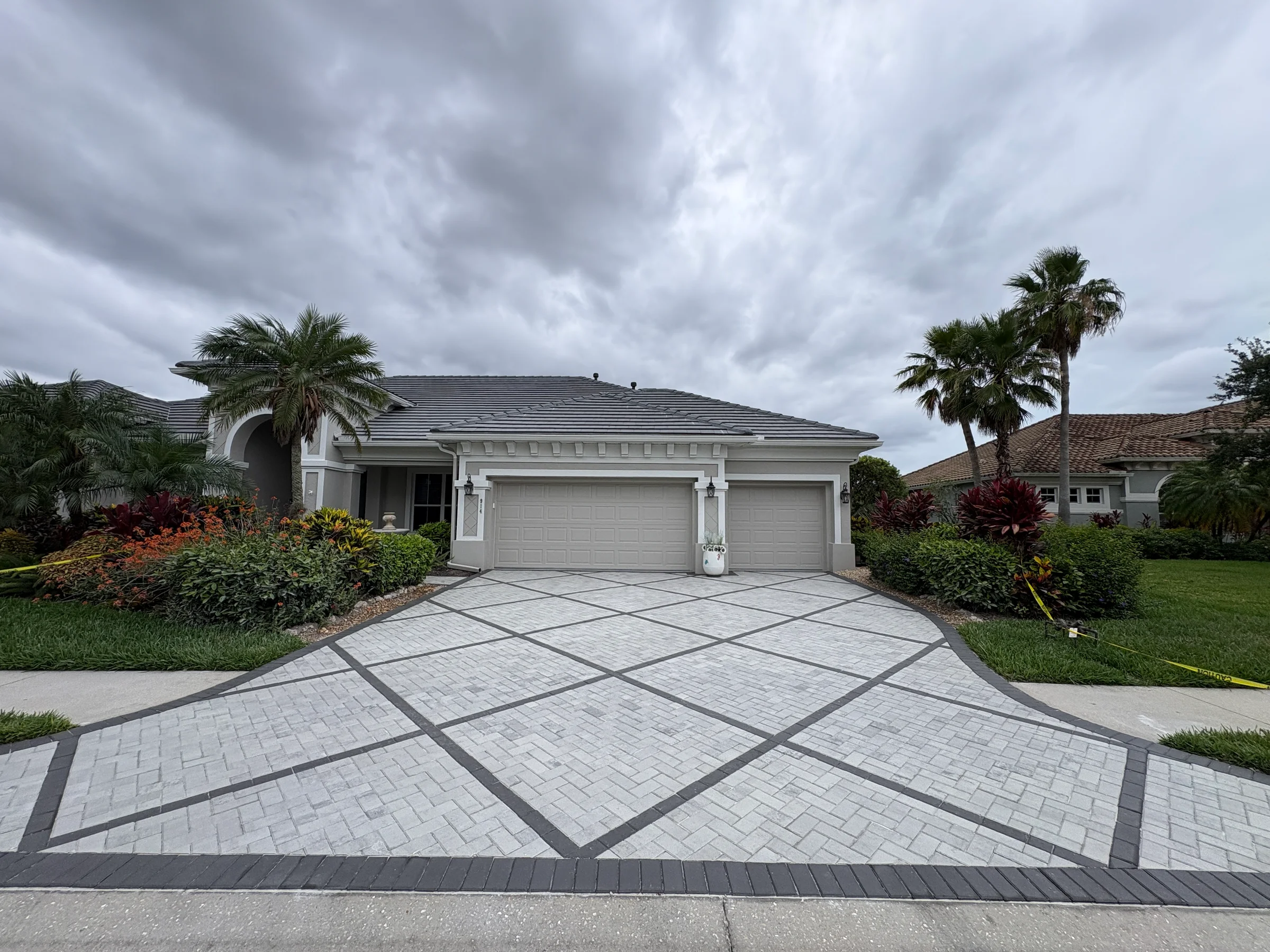
A paver driveway proposal should explain how the finished surface will meet the home, carry daily vehicle traffic, and move rainwater—not just show a paver color and a total price. In Lakewood Ranch, the property address, community criteria, existing elevations, and driveway connections can all influence the work. Use these seven questions to compare complete scopes before choosing a material or reserving a date.
1. What problem should the new driveway solve?
Begin with the reason for the project. You may be replacing a worn surface, addressing low areas or unstable edges, widening a parking area, changing the front elevation, or coordinating a driveway with new walks and landscaping. Those are different goals, and they can lead to different removal, preparation, drainage, and layout decisions.
Before an estimate, note cracks, settlement, standing water, tire-worn turns, stained areas, broken edges, garage-threshold issues, and any part of the current driveway that functions well. Wide photos taken after rain can be especially useful. A new paver field should be planned around the conditions that need attention rather than treated as a cosmetic layer over an unexplained problem.
2. How will the driveway meet the garage, street, sidewalk, and landscape?
Driveway transitions carry a lot of responsibility in a small amount of space. The garage threshold needs a clean meeting point. The street or apron connection affects arrival and may involve separate requirements. Public walks, utility covers, drains, steps, beds, and irrigation components can interrupt the field or define its edge.
Ask the estimator to walk these boundaries with you. Discuss where cuts and borders will land, how vehicles turn, which existing features remain, and how the pavers will be restrained at exposed edges. This is also the right time to identify whether a walkway or entry connection belongs in the same scope or should be clearly excluded.
3. Where will water go after a Florida downpour?
Drainage is a design question, not a final cleanup item. Note where water travels today, where it collects, and whether runoff approaches the garage, front walk, landscape beds, or a neighboring property. Existing low spots or blocked paths should be documented before the old surface is removed.
The proposal should make the intended finished grades and drainage responsibilities understandable. A paver pattern does not correct a site-wide water problem by itself, and the new surface should not simply move an existing problem to another edge. If drainage changes fall outside the driveway scope, that boundary should be clear before work is booked.
4. What does the estimate include below and around the pavers?
Square footage helps size a project, but it does not describe a complete installation. Ask how the written scope addresses demolition and hauling, excavation, anticipated base and setting-bed preparation, compaction, the specified paver, pattern, cuts, borders, edge restraint, joint material, transitions, drainage-related work, cleanup, and care information.
Also ask how concealed conditions will be handled if removal reveals something different from what was visible at the estimate. A clear change process is more useful than a broad allowance that leaves the contractor's response open-ended. When comparing proposals, align their project boundaries first; two totals are not comparable when one omits work the other includes.
5. Is a paver driveway cheaper than poured concrete?
There is no reliable yes-or-no answer for every Florida property. Pavers and poured concrete are different systems with different material, labor, preparation, detailing, and future repair considerations. Removal, access, grade correction, finish choices, patterns, borders, reinforcement or restraint, and transitions can shift either complete price.
Compare equivalent scopes rather than surface-only figures. Pavers offer individual units, modular repair possibilities, and wide pattern and border flexibility; concrete forms a continuous poured surface with its own finish and joint decisions. The useful choice is the system whose complete installation, appearance, ownership needs, and written price fit the property and household priorities.
6. Which selections and approvals must be settled before scheduling?
Lakewood Ranch extends into Manatee and Sarasota counties, and neighborhood requirements can differ. Ask for the current criteria tied to the property rather than relying on what was approved at another home. Community review and government requirements are separate: an association decision does not replace any approval that may apply to work near a sidewalk, apron, right-of-way, drainage feature, or utility.
Confirm who is responsible for each submission and what must be decided first. Paver manufacturer and product, color range, pattern, border, project limits, and visible transitions may all need to be settled before material is ordered. If you have a survey, community documents, or site plan, keep them with the proposal so the address and intended work remain connected throughout planning.
7. What happens between signing and driving on the finished surface?
Ask for the sequence as well as an anticipated installation window. Material availability, final selections, association or government review when applicable, utility coordination, site access, demolition, weather, and driveway complexity can all affect the calendar. The planning period and the days of work on site are related, but they are not the same timeline.
Clarify where household vehicles can park, how deliveries and equipment will reach the driveway, what adjacent areas need to stay clear, and when the finished surface can return to normal use. Then review the maintenance guidance for the exact paver and joint system. Routine sweeping, timely stain care, vegetation and joint upkeep, and attention to movement or drainage help owners catch small issues early; cleaning and sealing decisions should follow product-specific guidance.
Quick answers
Paver driveway FAQs for Lakewood Ranch homeowners
How much does it cost to install a paver driveway in Florida?
The complete cost depends on driveway size, removal, access, excavation, existing conditions, base preparation, drainage, paver selection, pattern, borders, cuts, edge restraint, joints, transitions, approvals, and cleanup. A site-specific written estimate is more useful than an online average.
Is a paver driveway cheaper than concrete in Florida?
Not in every case. Compare equivalent complete scopes for demolition, preparation, drainage, materials, details, transitions, access, cleanup, maintenance, and future repairs. The surface label alone does not determine the lower project price or better fit.
What should be included in a paver driveway proposal?
Look for defined project limits, removal and disposal, anticipated preparation, paver product and pattern, borders and cuts, edge restraint, joint material, transitions, drainage responsibilities, cleanup, care guidance, payment terms, and a written process for changes.
Do Lakewood Ranch driveway projects need HOA approval or permits?
Requirements vary by property, community, jurisdiction, and scope. Check current community criteria and applicable government requirements for the address, especially when work affects an apron, sidewalk, right-of-way, drainage, or utilities. One approval does not replace the other.
How long does a paver driveway installation take?
Timing varies with the project size and complexity, material availability, approvals when applicable, access, demolition, weather, and site conditions. Ask separately about pre-installation planning and the anticipated on-site work sequence.
What maintenance does a paver driveway need?
Typical care includes sweeping, prompt stain treatment, vegetation and joint upkeep, keeping drainage paths clear, and checking for movement at edges or transitions. Use cleaning, washing, and sealing methods appropriate to the selected paver and joint system.