
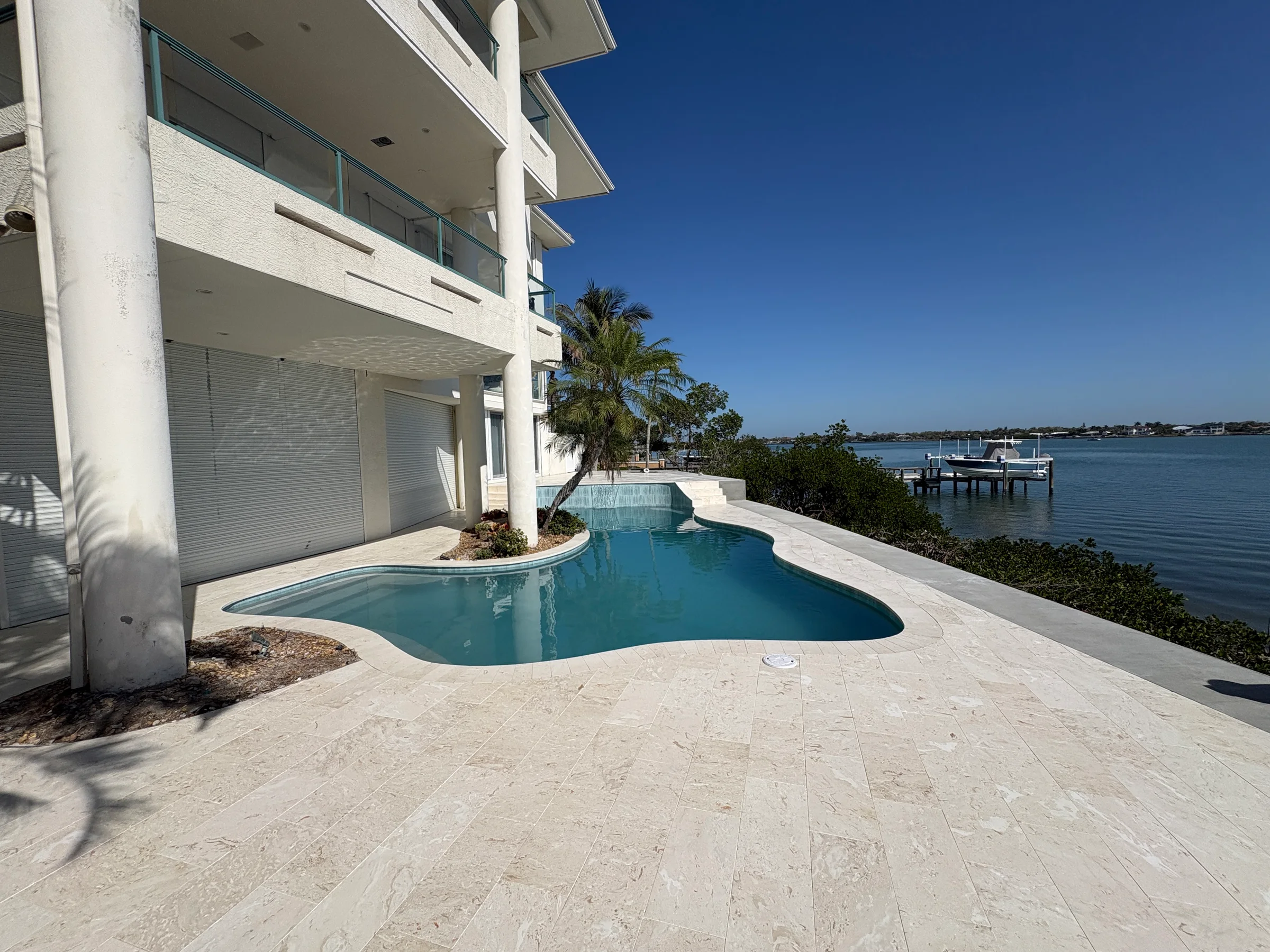
A marble pool deck is more than a light color choice. The exact stone and finish, natural variation, wet-use suitability, deck preparation, drainage, coping, care, and written project scope all affect whether the material fits a Lakewood Ranch property. These are the questions to resolve before comparing proposals or reserving an installation window.
Material snapshot
Pavers, travertine, and marble at a glance
| Surface | Visual character | Plan for | Care |
|---|---|---|---|
| Marble | Natural veining and tonal movement with a bright, refined architectural appearance. | Verify the exact product, finish, thickness, exterior use, wet-area suitability, range, and coping details. | Use stone-appropriate methods and account for acids, staining agents, pool splash-out, and any applied treatment. |
| Travertine | Natural pores, texture, edge character, and a warmer range that varies from piece to piece. | Review representative pieces, finish, format, pattern, wet-use suitability, and installation details. | Follow guidance for the selected stone and finish; do not assume acidic or aggressive cleaners are safe. |
| Concrete pavers | Manufactured formats with broad choices in color, texture, size, pattern, and borders. | Compare the specific product, surface feel, layout, cuts, joints, edge conditions, and coping transitions. | Plan for routine cleaning, joint upkeep, and product-specific washing or sealing decisions. |
Is marble a good material for a Florida pool deck?
Marble can be a strong pool-deck option when the selected paver and finish are intended for exterior wet areas and suit the homeowner's expectations for appearance and care. Natural veining and tonal variation can create a bright, expansive setting around the water. The broad label “marble,” however, does not establish that every product or finish is right for every pool.
Ask to review the exact material specification, not only a color name or a single photograph. Surface finish affects texture and appearance, while thickness, format, coping compatibility, and installation details affect the complete assembly. Evaluate a representative group of pieces in daylight and expect the installed field to show natural range rather than repeat one ideal sample.
Wet-foot traffic deserves a product-specific discussion. No pool deck should be treated as slip-proof, and suitability cannot be inferred from stone type alone. Compare the selected finish under the conditions in which it will be used, then factor in drainage, slope, splash-out, cleaning, and the paths people take between the pool, lanai doors, furniture, and yard.
How does marble compare with travertine and concrete pavers?
The useful comparison is between specific products and complete project scopes. Marble is commonly chosen for veining, tonal movement, and a refined look. Travertine brings its own pores, texture, warmer range, and edge character. Concrete pavers provide manufactured consistency and broad flexibility in color, format, pattern, and borders. Each category still contains finishes and products with different characteristics.
Place real samples beside the pool finish, coping, home exterior, enclosure frame, and other materials that will remain. Look at them in direct sun and shade, dry and damp when the supplier's guidance allows. Ask how the pattern will handle curves, drains, narrow sections, steps, and door landings. A material that looks compelling in isolation still needs to resolve the entire perimeter.
Maintenance and budget also belong in the comparison. Natural stone can be sensitive to acidic products and staining agents, while concrete paver systems have their own joint and surface-care needs. The right choice is the one whose exact finish, variation, installation requirements, care routine, and complete cost make sense for the property—not the material with the strongest general claim online.
How much does a marble pool deck cost?
A square-foot price can be a starting reference, but it is not a reliable project total without the rest of the scope. Marble selection and availability, deck area, demolition, hauling, access, excavation, the condition below the existing surface, preparation, drainage changes, coping, curves, cuts, steps, drains, borders, enclosure conditions, and cleanup can all affect an estimate.
Two decks with similar square footage can require different work. One may have open equipment access and straightforward edges; another may be inside an existing screen enclosure with narrow gates, settled areas, multiple drains, curved coping, and thresholds that must remain at fixed elevations. Ask estimators to measure and describe those conditions rather than applying one average rate to both.
Compare written proposals line by line. The project area, material and finish, pattern, removal, preparation, installation assembly, cuts, coping and transition work, drainage responsibilities, joint treatment, cleanup, care information, change process, payment schedule, and any written warranty terms should be clear. If an item is not included, the proposal should make that boundary understandable before booking.
Should an existing pool deck be resurfaced or replaced?
Resurfacing and replacement solve different problems. A coating or overlay changes an existing surface within the limits of that system. A new marble paver deck involves a different material and installation scope. The right path begins with the condition of the current deck and the result the homeowner wants—not with assuming one approach fits every crack, stain, low spot, or outdated finish.
Document cracked or moving areas, uneven transitions, standing water, damaged coping, old enclosure anchors, drains, thresholds, and signs of settlement. Cosmetic work cannot resolve every underlying movement or drainage issue. A site evaluation should identify which existing conditions are expected to remain, which need correction, and what could only be confirmed after removal.
For replacement work, ask how the old surface will be removed and hauled away, how access and pool protection will be handled, and how the new deck will meet coping, doors, drains, equipment pads, screen walls, and adjoining patios. Those transitions often determine whether the completed pool area reads as one resolved space.
What Lakewood Ranch details should be checked before booking?
Lakewood Ranch includes communities in both Manatee and Sarasota counties, so the property address helps determine which government requirements apply. A neighborhood or association may also have a separate review process for visible materials, colors, drainage, landscape impacts, construction access, or required documents. Community approval and government requirements are separate questions.
Request the current property-specific criteria rather than relying on what was accepted for another home. If available, gather a survey, pool or deck plans, community documents, site photos, and notes about future work such as a screen enclosure or outdoor kitchen. Confirm who is responsible for required submissions and what must be approved before materials are ordered or work is scheduled.
Florida rain makes drainage an early design issue. Note where water moves now, where it collects after a storm, and how the deck connects to the home, pool, drains, enclosure, landscape, and neighboring grades. A new surface should be planned around a lawful drainage path rather than expected to hide an unresolved elevation problem.
How long does installation take?
The full calendar includes more than days spent installing stone. Final measurements, material selection and availability, sample or association review, permits when applicable, site access, demolition, supporting work, coping or drainage coordination, weather, and current scheduling can all affect timing. Ask for the planning path and anticipated on-site sequence as two related parts of the schedule.
Before booking, confirm when selections become final, what must happen before the start date, how the pool and surrounding areas will be protected, and whether the pool can be used during the work. If an enclosure, pool renovation, landscaping, or outdoor kitchen is part of the larger project, the proposed sequence should identify which work comes first and which finished surfaces need protection.
What maintenance does outdoor marble require?
Pool splash-out, sunscreen, organic debris, furniture, metal objects, and Florida moisture can all affect an outdoor stone surface. Prompt rinsing and cleaning with methods appropriate to the exact marble and finish help protect its appearance. Acidic household products and aggressive cleaning can etch or alter natural stone, so product guidance should lead the care plan.
Sealing is not a one-calendar answer for every marble deck. The stone, finish, porosity, exposure, pool environment, products previously applied, and manufacturer or stone-care guidance all matter. Ask whether a treatment is proposed, what appearance it may create, what it is intended to do, and what future cleaning or reapplication would involve.
Keep drains and edges clear, address stains promptly, and watch for movement, cracked pieces, uneven transitions, or persistent water. Store the material information, written scope, care guidance, and any product or workmanship terms together. That record gives future cleaning and repair decisions a better foundation than guessing from the word “marble” alone.
Quick answers
Lakewood Ranch marble pool deck FAQs
Is marble good for a pool deck in Florida?
It can be when the exact marble paver and finish are intended for exterior wet areas and fit the project's appearance, texture, installation, and maintenance needs. Verify product suitability rather than assuming every marble or finish performs the same way.
How much does a marble pool deck cost per square foot?
A square-foot rate does not capture the full project. Material and availability, removal, access, preparation, drainage, coping, curves, cuts, steps, drains, enclosure conditions, and cleanup can all affect the estimate. Compare complete written scopes after a site review.
Is marble or travertine better for a pool deck?
Neither is universally better. Compare the exact marble and travertine products for finish, wet-use suitability, natural variation, pattern, installation details, care expectations, availability, and total project cost.
Will marble pavers vary in color and veining?
Yes. Marble is natural stone, so tonal range and veining are expected. Review multiple representative pieces and discuss how the material range will be distributed across the deck.
Should a marble pool deck be sealed?
There is no universal answer or schedule for every deck. The stone, finish, porosity, exposure, pool environment, proposed treatment, and manufacturer or stone-care guidance should determine whether sealing is appropriate and how it is maintained.
What should be avoided when cleaning marble?
Do not assume acidic household products, harsh chemicals, or aggressive pressure washing are safe. Follow cleaning guidance for the exact stone, finish, joint system, and any applied treatment, and test unfamiliar products in a discreet area when appropriate.
Do Lakewood Ranch pool deck projects need HOA approval or permits?
Requirements vary by property, community, jurisdiction, and scope. Check current association criteria and applicable government requirements for the address before ordering materials or scheduling work; one approval does not replace the other.